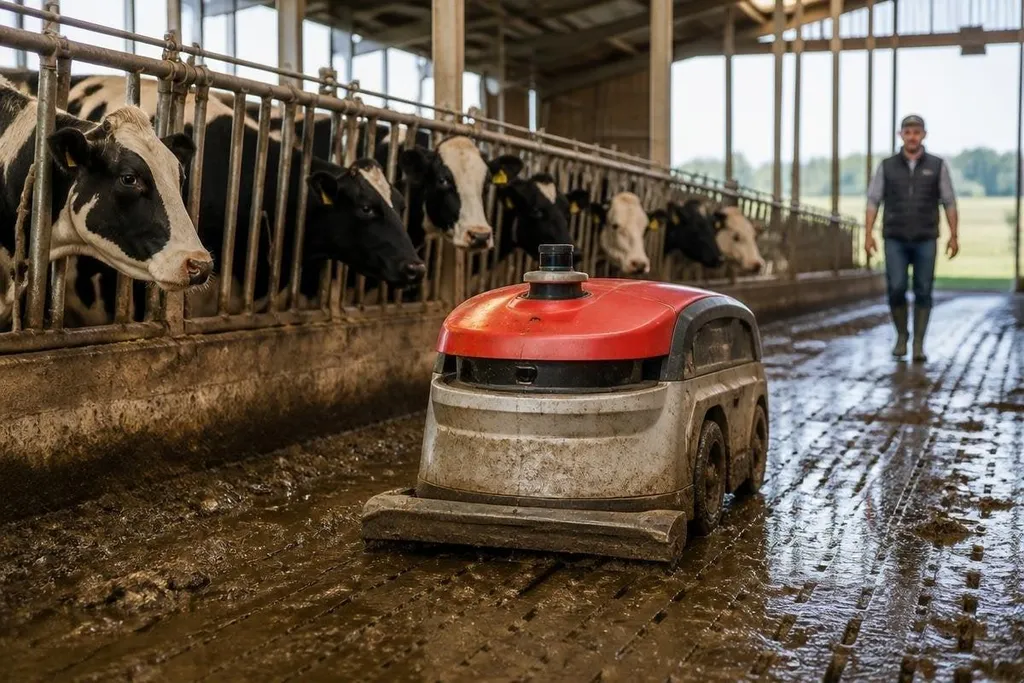
A livestock robot has to work around animals, wet ground, dust, gates, feed, and people. A lab demo can prove that a machine moves; a farm needs proof that it keeps working through a full routine.
- The useful test is a repeated farm task, not a short video.
- Animal safety and human control need clear limits.
- Service time may matter as much as speed.
The work comes before the robot
The next generation will start with narrow jobs. A machine may check feed, move through a barn, watch animal movement, clean a floor, or carry supplies between buildings. Each task has a different risk, route, and need for human control.
That matters because farms rarely offer a clean path from one action to the next. A robot may find a closed gate, a wet patch, a loose cable, or an animal blocking its route. The machine needs a safe response for each case, and the farm team needs to know what it will do.
A useful system also needs a clear handoff. If the robot stops, a worker should see the reason, reach the machine, and put it back into service without a long search through menus.
What the next generation must prove
Sensors can help a robot see animals and read its surroundings. Cameras may identify movement, while depth sensors help the machine judge distance from walls, gates, and bodies. The exact sensor mix will depend on the barn and the task.
The hard part is repeatable work. A robot that finds one animal during a test has shown detection. A farm needs to know how often it detects the right animal, what happens when animals crowd together, and how the system records a missed check.
The same rule applies to movement. A robot that crosses a dry floor has passed one test. Its maker still needs to show how it handles mud, slopes, narrow passages, poor light, and surfaces that change during the day.
Animal movement adds a harder safety check than mud or slopes. Reporting from Robot24.com can tie a livestock robot’s route to animal distance, stop time, and operator action when a cow changes direction. Those details lead into the next test: can the system protect animals and staff when the space changes without warning?
Animals change the safety problem
A livestock robot cannot treat every object as a fixed obstacle. Animals move without warning, gather in groups, and may react to sound or motion. The robot must keep enough distance, limit its force, and stop when its sensors cannot judge the situation.
Farm staff need control that works near the machine. A visible stop control, a clear warning, and a safe restart process matter more than a long feature list. The system should also record stops and faults so the farm can find repeated problems.
I’d wait for makers to publish animal-safety tests before buying a robot for work near livestock. A promise to “work alongside animals” leaves too much unsaid unless the maker names the animals, task, setting, and test result.
The farm must be able to keep it running
Service work can decide whether a robot earns its place. The buyer needs to know how the machine charges, where it stores data, how staff clean it, and which parts they can replace on site.
A farm also needs a plan for weak signals and power loss. The robot should stop in a known safe place, keep its task record, and tell a worker what happened when the connection returns. If a fault needs a specialist visit, the maker should state that before the sale.
The price is only one part of the decision. Time spent charging, cleaning, checking alerts, and waiting for service changes the labor the robot can actually save.
A buying checklist
Use these questions before a farm trial:
- Name the task: What does the robot do during a normal shift?
- Check the setting: Has it run in the actual barn, yard, or pasture?
- Set safety limits: What distance, force, and stop rules protect animals and staff?
- Test failure recovery: Who restarts it after a blocked route, low battery, or lost signal?
- Count service work: How often must staff clean, charge, inspect, or reset it?
- Ask for proof: Which results come from a farm trial rather than a controlled demo?
The next useful livestock robot will be easy to judge. Its maker will name the task, publish the limits, show repeated farm work, and explain what happens when the machine stops. Until those details are public, the open question is not whether the robot can move through a barn, but whether a farm can depend on it every day.